enroll by July 28th to receive Up to a $500 tuition grant + an additional 25% off Multiple Courses

the addictions academy
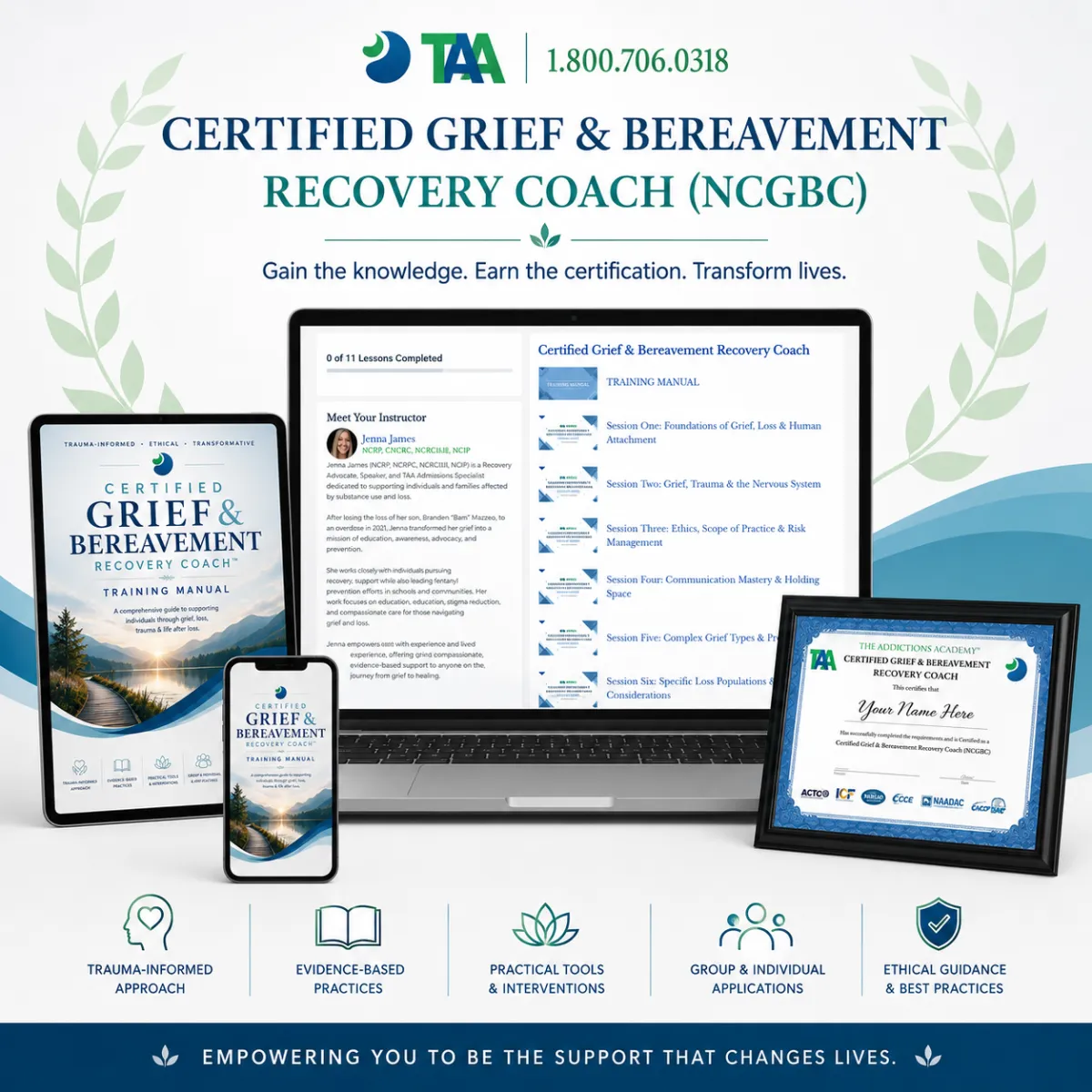
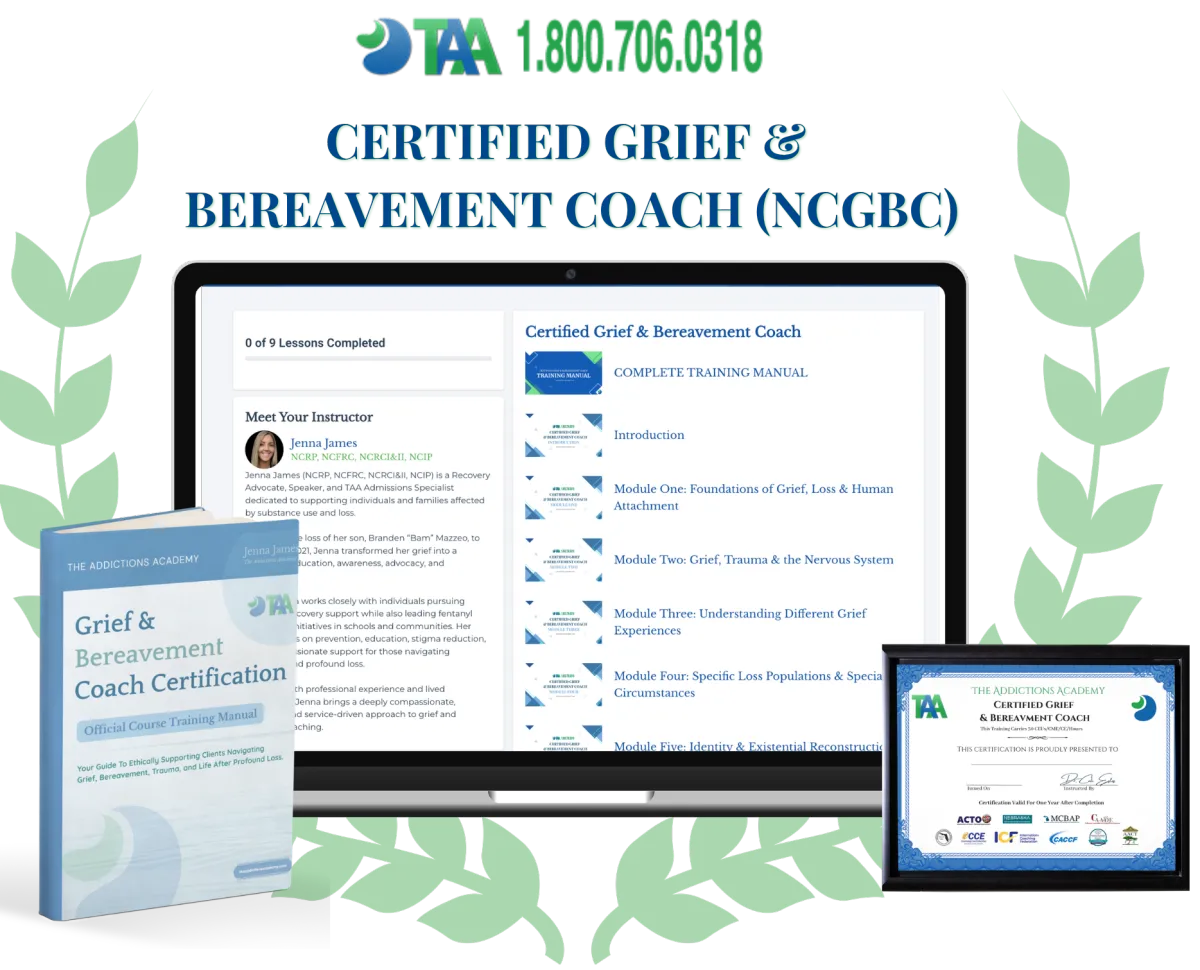
Become A Nationally Certified Grief & Bereavement Coach
● Internationally Accredited ● no prior-experience required ● Fast-Track Online Certification
Learn how to ethically, confidently, and compassionately support individuals navigating grief, trauma, bereavement, and life after profound loss.
Most people want to help the grieving… But have no idea how.
The Nationally Certified Grief & Bereavement Coach Training is a trauma-informed professional certification designed to prepare coaches, helping professionals, and purpose driven individuals to ethically support clients navigating grief, bereavement, trauma, and life after profound loss.

Grief is one of the most misunderstood human experiences. Despite the best intentions, most people default to phrases that minimize, dismiss, or rush the grieving process often making the bereaved feel more alone.
Whether loss comes through death, illness, addiction, divorce, miscarriage, caregiving, identity disruption, or life transition, grief affects far more than emotion alone. It reshapes cognition, physiology, relationships, spirituality, and one’s sense of meaning in the world.
This certification provides a comprehensive, clinically informed framework for understanding grief and supporting others with confidence, compassion, and professional integrity.
A complete certification: from foundations to practice.
Format
100% Online, Self-Paced
Prerequisites
Zero Prior Experience Needed
Curriculum
7 Modules With Real Client Exercises
Examination
Testing & Credentialing Fees Included
Support
10 Weeks of Live Group Mentorship
duration
6 Months On Demand Access
Tuition
$999 one-time payment
Grief Is Not Rare...
Grief Support Is
The data makes one thing undeniable: grief is one of the most universal human experiences and one of the most underserved. Trained grief coaches are not a luxury. They are a necessity.
86%
of people over 16 have experienced significant grief from the loss of a loved one
Grief & Bereavement Statistics, 2025
2.5M
people die in the US each year each leaving an average of 5 grieving people behind
Recovery Village / CDC
1,089+
children in the US become newly bereaved every day & most will never get professional support
WebMD / LA Outpatient Center, 2025

— Why This Exists
Born from loss.
Built for those called to help.
The Addictions Academy Coach Jenna James built this certification from the hardest place imaginable the loss of a child. What she found in that grief was a calling: to train a generation of practitioners who could hold space for others with the skill and grounding that she, in her own darkest hours, wished had been available.
" Following the loss of my son, Branden 'Bam' Mazzeo, to fentanyl in 2021, I Know that grief doesn't end, it transforms. And I knew that the people who walk alongside the grieving need more than good intentions. They need a framework. They need training. They need to know what they're doing. "
Every lesson in this curriculum was shaped by real loss, real recovery work, and real clients. Not theory for its own sake but clinical grounding in service of genuine human healing.
The grief coaching field is growing because the need is undeniable. More than 2.5 million Americans lose someone close to them every year. Most of them will never access therapy. They need coaches, trained, ethical, compassionate coaches , who can meet them where they are.
— Career Paths
What You Can Do As a Nationally Certified Grief & Bereavement Coach
The grief coaching field is growing, and underserved. This credential positions you to work across multiple contexts, either independently or alongside other professionals.
Work Directly With Grieving Individuals & Families
Support clients navigating the loss of a loved one, a relationship, a career, a health diagnosis, or any significant life change — guiding them through the grief process with clinical grounding, ethical practice, and the GRACE Method™ framework.
Integrate Into Hospice, Palliative Care & Healthcare Teams
Collaborate with nurses, social workers, physicians, and palliative care specialists in residential, outpatient, or home-based settings — bringing a specialized grief coaching perspective that most clinical teams currently lack.
Build a Private Grief Coaching Practice
Offer one-on-one coaching, group programs, online courses, or workshop-based services focused specifically on grief and bereavement recovery. Module 12 gives you the pricing, packaging, and marketing infrastructure to launch immediately upon certification.
Expand Your Role in Your Existing Field
Apply grief coaching tools within your current professional context — whether you work in mental health, addiction recovery, life coaching, faith ministry, social work, or community support. Most helping professionals encounter grief regularly; this training gives you the framework to meet it with confidence.
Partner With Faith Communities & Nonprofit Organizations
Bring structured, professional-grade grief support to churches, mosques, synagogues, employee assistance programs, community grief groups, and bereavement ministries — filling a critical gap that pastoral care alone often cannot address.
Step Into a Growing, Underserved Field
With 2.5 million deaths annually in the US — each leaving an average of 5 grieving people behind — and a healthcare system that offers little ongoing bereavement support beyond 3–4 days of leave, the demand for trained grief coaches is significant and accelerating. This certification positions you to meet that need with credibility and clarity.
— The addictions academy's Proprietary Methodology
The GRACE Method™
Our signature proprietary five-step coaching framework, a structured, compassionate approach to guiding clients through every stage of grief, from first session to completion.
You'll be trained to confidently support clients through:
This curriculum doesn't just cover grief generically; it trains you in the specific dynamics, language, and coaching approach each type of loss requires.
Traumatic Grief
Sudden, violent, or shocking loss that overwhelms the nervous system's capacity to integrate — requiring specialized, paced support.
Suicide Loss
Complex guilt, unanswered questions, stigma, and significant trauma overlap — one of the most demanding grief presentations a coach will face.
Addiction & Overdose Loss
Stigma-heavy grief layered with ambivalence, relief, shame, and complicated pre-loss relationship dynamics.
Miscarriage & Fertility Loss
Often invisible and deeply disenfranchised grief — frequently minimized by others and unrecognized as legitimate bereavement.
Identity Loss
Health diagnosis, career loss, relationship endings, and major life transitions — grief without a death, but loss that cuts just as deep.
Family System Conflict
When grief is tangled in family dysfunction, estrangement, or competing mourning styles — requiring skill in navigating relational complexity.
— The Curriculum
7 modules. Every dimension of grief.
Built on the latest grief science from nervous system regulation and attachment theory to meaning reconstruction and cultural humility,
100+ key topics designed for immediate application, not just conceptual understanding.
— meet your instructor
Jenna James
Recovery Advocate · Speaker · TAA Admissions Specialist

Jenna James
NCRP · NCFRC · NCRCI&II · NCIP · NCGBC
— meet your instructor
Jenna James
Recovery Advocate · Speaker · TAA Admissions Specialist
Jenna James has dedicated her career to supporting individuals and families affected by substance use and loss. Her path into this work is not theoretical; in 2021, Jenna lost her son, Branden "Bam" Mazzeo, to fentanyl. What followed was a profound transformation: turning personal grief into a mission of education, awareness, and connection.
Today, Jenna works closely with individuals seeking to enter the recovery and grief support field, helping guide them toward purposeful, service-driven careers. She is deeply involved in fentanyl awareness initiatives, speaking in schools and communities to shed light on the risks of illicit substances and the growing impact of the opioid crisis with a focus on prevention, education, and breaking stigma.
"I built this work from the hardest place imaginable. I teach it so that others can do this work well — with the skill, the grounding, and the heart it requires."
Through both her professional work and personal advocacy, Jenna brings a compassionate and relatable perspective that few instructors can match. She meets people where they are without judgment, and helps others find meaning and direction even in the face of profound loss.
Six reasons this
certification works.
Most people who want to support the grieving don't lack compassion, they lack a clinical framework for doing it safely and effectively. This certification closes that gap, moving you from good intentions to grounded expertise you can charge for.
It's Grounded in Grief Science
Every framework — Worden, Dual Process, Continuing Bonds, nervous system regulation — is taught not as theory but as a coaching tool you'll actually apply in session.
You Leave With a Methodology
The GRACE Method™ is yours — a proprietary five-step framework with session guides, scripts, and client exercises built in. You're not figuring out what to do in the room.
Ethics Are Non-Negotiable
An entire module covers scope of practice, crisis indicators, when to refer, and the precise line between coaching and therapy. You'll know exactly who you are — and who you are not.
Live Mentorship Is Included
Ten weeks of live group mentorship with a Master Coach means you're never navigating difficult client situations alone. Real cases, real guidance, real support.
It Covers Every Type of Loss
Child loss, suicide loss, miscarriage, pet loss, divorce, health diagnosis — no two grief experiences are alike. You'll be trained to meet clients in the specific reality of what they've lost.
You Graduate Practice-Ready
Pricing, packaging, marketing, referral partnerships, intake forms — Module 12 gives you the operational infrastructure to accept your first paying client within weeks of completing the program.
— Your Path Forward
From enrollment to practicing coach
Becoming a Nationally Certified Grief & Bereavement Coach is a clear, step-by-step pathway...
Enroll & Get Started Today
Your full curriculum is available immediately upon enrollment, allowing you to move through all 12 modules on a schedule that works for your life, career, and responsibilities. Whether you prefer to complete the program quickly or take time to absorb the material more deeply, the structure is entirely self-paced.
Build Real Coaching Confidence With Practical Support
Throughout the program, you’ll receive practical coaching tools designed for immediate implementation—including session frameworks, coaching scripts, client exercises, and ready-to-use resources that help bridge the gap between learning and practice. In addition, you’ll receive 10 weeks of live group mentorship with a Master Coach, where you can discuss case scenarios, ask questions, and strengthen your confidence in a supportive professional environment.
Graduate Ready to Begin Practicing
When you pass your final exam, you’ll have more than a credential; you’ll have a practical framework for using these skills in a meaningful way. Whether that means supporting clients within your current professional role, expanding the services you already offer, or pursuing independent coaching opportunities, the program is built to help you translate education into real-world impact.
Still Have Questions? Here's Our FAQ
You may also call us at 1-800-706-0318 ext 2 | Text us at 323-274-1840 | Email us at [email protected]

The World’s Premier Training Institute for Mental Health & Addiction Professional Development.
The Addictions Academy Ⓡ
2046 Treasure Coast Pkwy Unit A, #207 Vero Beach FL 32960
Quick Links


